By Oliver Pack (Medical Doctor – Reg. No. 030308944).

After several weeks of medication, monitoring appointments and procedures, the time finally comes to transfer the embryo into the uterus and begin the wait to find out whether treatment has been successful.
It is only natural to have lots of questions at this stage. Do I need to rest? Can I exercise? Are there foods that help implantation? Is it safe to have sex? And what if I don't notice any symptoms?
Preparation will depend on the type of treatment you are having and the protocol being followed. That is why it is important to take your prescribed medication as directed and follow your medical team's advice.
Generally speaking, there is no need to make major changes to your diet in the days leading up to the transfer, and no particular routine has been shown to improve implantation. You should also avoid starting supplements, medicines or herbal remedies on your own in the hope of improving your chances of success.
Many patients wonder whether certain foods can help an embryo implant in the uterus. Pineapple, avocado, nuts, pomegranate and antioxidant-rich foods are often mentioned in this context.
However, no single food has been proven to increase the chances of implantation. Researchers have looked at various dietary patterns and their relationship with fertility and assisted reproduction outcomes, but there is no evidence that any particular diet or food can make an embryo implant.
The best approach, both before and after transfer, is therefore to eat a varied, balanced diet that includes fruit and vegetables, wholegrains, pulses, good-quality protein, fish, nuts and healthy fats. It is also important to prepare meals using fresh ingredients and avoid ready meals and, in particular, heavily processed foods.
After transfer, it is also sensible to follow the usual food safety advice for pregnancy: wash fruit and vegetables thoroughly, avoid raw or undercooked meat, fish and shellfish, and take care with certain unpasteurised products and fish that contain high levels of mercury.
No. Complete bed rest after embryo transfer does not increase the chances of pregnancy.
For many years, patients were advised to lie down after the procedure out of concern that moving around might interfere with implantation. However, getting up, walking and going about your normal daily activities will not cause the embryo to move or 'fall out' of the uterus.
The American Society for Reproductive Medicine (ASRM), for example, concludes that there is sufficient evidence not to recommend bed rest after embryo transfer. Unless there is a specific medical reason to do otherwise, you can therefore return to an almost normal routine once you leave the clinic.

Staying active after embryo transfer does not reduce your chances of becoming pregnant. A prospective study published in Reproductive BioMedicine Online recorded patients' step counts between embryo transfer and their pregnancy test and found no negative association between walking and pregnancy rates.
Of course, that does not mean you should start a new training programme or increase the intensity of your workouts during the two-week wait. The aim is simply to carry on with your usual activities.
If the transfer follows ovarian stimulation, your ovaries may still be enlarged. High-impact activities, sudden movements and strenuous exercise may therefore be uncomfortable or temporarily inadvisable. Advice should be tailored to the treatment you have had, your usual level of activity and how you feel after the procedure.
| Activity or habit | General recommendation after embryo transfer |
| Walking | Yes. You can walk and move around as normal, and there is no need to remain lying down. |
| Working | Generally yes, provided that your job does not involve significant physical effort or there is no specific medical recommendation to the contrary. |
| Bed rest | It is not routinely recommended, as it has not been shown to increase the chances of pregnancy. |
| Moderate exercise | In general, this can be maintained, adapting it to how the patient feels and the type of treatment carried out. |
| Intense or high-impact exercise | It may be advisable to reduce it temporarily, especially after ovarian stimulation or if there is any discomfort. |
| Sexual intercourse | There is no universal recommendation for abstinence. The specific instructions provided by the clinic should be followed, and intercourse should be avoided if there is pain, bleeding or any other circumstance that makes it advisable. |
| Usual diet | Yes. The most appropriate approach is to maintain a varied and balanced diet, without the need to eat specific foods to support implantation. |
| Coffee and other caffeinated drinks | These can be consumed in moderation, trying not to exceed approximately 200 mg of caffeine per day. |
| Alcohol and smoking | They are not recommended. From the time of embryo transfer onwards, it is advisable to take the same precautions as during a possible pregnancy. |
| Medication and supplements | The medication prescribed by the specialist should be continued, and treatments or supplements should not be started or stopped without medical advice. |
These recommendations are general in nature, although the instructions given by the medical team should always take priority.
This is another question that comes up frequently in consultations. There is currently no universal recommendation to abstain from sex after embryo transfer. So far, no clear adverse effect on pregnancy rates has been established for sexual intercourse after transfer.
However, your specialist may advise avoiding sex temporarily in certain circumstances, such as bleeding or pain, ovaries that remain enlarged after stimulation, or other factors specific to your treatment.
You may notice certain symptoms in the days after transfer, but they do not necessarily mean that treatment has failed — or that it has worked. Some of the most common are:
These symptoms cannot tell you whether the embryo has implanted successfully. They may be caused by the procedure itself or by the hormonal medication you have been taking. Equally, having no symptoms does not mean that the transfer has failed. Everyone responds differently, and it is entirely possible to become pregnant without noticing any changes in the first few days.
Mild discomfort or any of the symptoms mentioned above does not necessarily mean anything is wrong. However, you should contact your medical team if you experience heavy bleeding, a fever, feel significantly unwell, or have severe or worsening abdominal pain.
It is also worth remembering that, after a fresh embryo transfer, some symptoms may be related to the ovaries' response to stimulation. Not every symptom should automatically be attributed to implantation.
The two-week wait (TWW) can be a time of considerable anxiety and uncertainty, leading many people to take a pregnancy test before the results can be considered reliable.
The exact timing depends on the treatment protocol and the developmental stage of the embryo transferred. As a general guide, pregnancy testing is carried out around 10–14 days after embryo transfer.
In assisted reproduction, pregnancy is usually confirmed with a blood test measuring beta-hCG, a hormone that begins to be produced after implantation. Testing too early can produce a false-negative result because hCG levels may still be too low to detect. In some treatment cycles, hCG is also used to trigger the final maturation of the eggs before egg collection, so an early test could be affected by the hCG given as part of treatment.
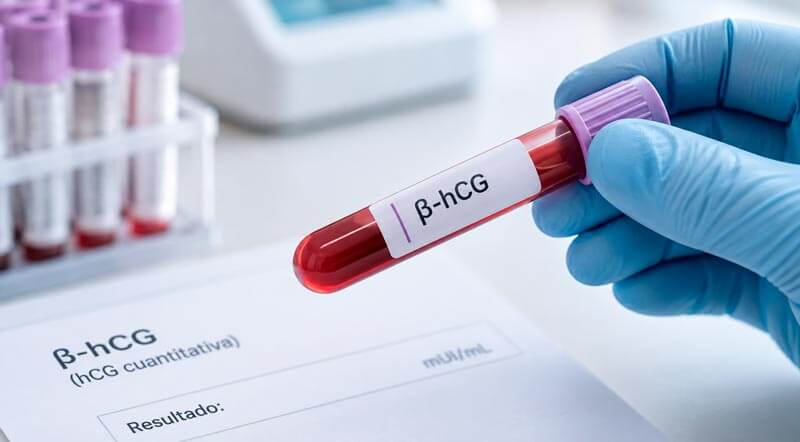
For these reasons, however difficult the wait may be, it is best to test on the date provided by your clinic and not to change or stop any prescribed medication without medical advice.
From the moment the embryo is transferred, the safest approach is to act as though you may already be pregnant. This means avoiding alcohol, smoking, nicotine products, cannabis and other recreational drugs.
During pregnancy, the usual recommendation is to limit caffeine to no more than 200 mg a day. Remember that caffeine is found not only in coffee, but also in tea, some energy drinks and soft drinks, chocolate and certain supplements.
You should also follow standard pregnancy food safety precautions, avoiding raw or insufficiently cooked meat, fish and shellfish, as well as foods that carry a higher risk of foodborne infection. Finally, do not start taking medicines, nutritional supplements or herbal products without checking with your specialist first. Just because something is labelled 'natural' does not necessarily mean it is safe during pregnancy or compatible with medication used in fertility treatment.
Practice Committee of the American Society for Reproductive Medicine (ASRM).
Performing the embryo transfer: a guideline.
.
2017;
882-896
Publicación científica sobre las técnicas de transferencia embrionaria y las recomendaciones basadas en la evidencia para optimizar los resultados reproductivos:
https://www.asrm.org/practice-guidance/practice-committee-documents/performing-the-embryo-transfer-a-guideline-2017/
Zemet R, Orvieto R, Watad H, Barzilay E, Zilberberg E, Lebovitz O.
The association between level of physical activity and pregnancy rate after embryo transfer: a prospective study.
.
2026;
930-937
Estudio prospectivo que analiza la asociación entre el nivel de actividad física después de la transferencia embrionaria y las tasas de embarazo en pacientes sometidas a reproducción asistida:
https://doi.org/10.1016/j.rbmo.2021.01.013
Craciunas L, Tsampras N.
Bed rest following embryo transfer might negatively affect the outcome of IVF/ICSI: a systematic review and meta-analysis.
.
2016;
16-22
Revisión sistemática y metaanálisis que evalúa el efecto del reposo en cama después de la transferencia embrionaria y su posible influencia sobre los resultados de los tratamientos de FIV e ICSI:
https://pubmed.ncbi.nlm.nih.gov/26986834/
Sanderman EA, Willis SK, Wise LA.
Female dietary patterns and outcomes of in vitro fertilization (IVF): a systematic literature review.
.
2022;
5
Revisión sistemática de la literatura científica sobre la relación entre los patrones de alimentación y los resultados de los tratamientos de fecundación in vitro:
https://nutritionj.biomedcentral.com/articles/10.1186/s12937-021-00757-7
American College of Obstetricians and Gynecologists (ACOG).
Moderate Caffeine Consumption During Pregnancy. Committee Opinion No. 462.
.
2010;
467-468
Opinión de comité publicada en una revista médica sobre el consumo moderado de cafeína durante el embarazo y la evidencia disponible acerca de sus posibles efectos sobre la gestación:
https://www.acog.org/clinical/clinical-guidance/committee-opinion/articles/2010/08/moderate-caffeine-consumption-during-pregnancy
U.S. Food and Drug Administration (FDA).
Advice about Eating Fish: For Those Who Might Become or Are Pregnant or Breastfeeding.
.
2024;
Recomendaciones de la FDA sobre el consumo de pescado durante la planificación del embarazo, la gestación y la lactancia:
https://www.fda.gov/food/consumers/advice-about-eating-fish
Hamoda H, Drakeley AJ, Brian K, Evbuomwan IO, Mathur R.
The Management of Ovarian Hyperstimulation Syndrome. Green-top Guideline No. 5.
.
2026;
e50-e69
Publicación clínica sobre la identificación, evaluación y tratamiento del síndrome de hiperestimulación ovárica, una posible complicación de los tratamientos de reproducción asistida:
https://obgyn.onlinelibrary.wiley.com/doi/10.1111/1471-0528.70195
Lundin K, Bentzen JG, Bozdag G, Ebner T, Harper J, Le Clef N.
Good practice recommendations on add-ons in reproductive medicine.
.
2023;
2062-2104
Publicación científica de recomendaciones sobre la eficacia, seguridad y evidencia disponible de las técnicas y tratamientos complementarios utilizados en medicina reproductiva:
https://pubmed.ncbi.nlm.nih.gov/37747409/
Privacy Policy
IVF-LIFE, hereby informs you of its privacy policy applied to personal data. The use of the website does not imply that the user must provide any information regarding their identity, and cannot be associated with a specific user by the company. In the event that personal data is provided, this data will be collected and used in accordance with the limitations and rights set out in the aforementioned regulation.
WHO IS RESPONSIBLE FOR THE PROCESSING OF YOUR DATA?
DATA CONTROLLER: IVF SPAIN ALICANTE S.L.U (hereinafter IVF-Life)
CIF: B-54973227
Postal Address: Avenida de Ansaldo, no. 13, 03540, Alicante (Alicante)
Contact with the Data Protection Officer: dpo@ivf-life-group.com
DATA CONTROLLER: Instituto Vasco de Fertilidad (hereinafter IVF-Life)
CIF: B95575874
Postal Address: Avenida de Tolosa, 71-73, 20018 Donostia / San Sebastián (Spain)
Contact with the Data Protection Officer: dpo@ivf-life-group.com
DATA CONTROLLER: IVF Spain Madrid (hereinafter IVF-Life)
CIF: B 85138113
Postal Address: C/ de Manuel de Falla, 6-8, 28036 Madrid (Spain)
Contact with the Data Protection Officer: dpo@ivf-life-group.com
WHAT TYPE OF DATA DO WE PROCESS?
Depending on the products, services, or functionalities that you wish to enjoy, we may need to process different types of data. In general, this data will be, depending on the case, the following:
- Your identification data: for example: name, surname, language, country from which you interact with us, contact details, etc.
- Connection, geolocation and navigation data.
- Commercial information if you are subscribed to our newsletter.
- Data about your tastes and preferences.
WHAT IS THE ORIGIN OF THE DATA?
The use of certain services or requests addressed to IVF-LIFE are subject to the prior completion of the corresponding form. All the information provided by the User through the forms on the Portal for the above purposes or any other must be truthful.
To this end, the User guarantees the authenticity of all the data provided and will keep the information provided to IVF-LIFE perfectly up to date so that it corresponds at all times to the User's real situation. In any case, the User will be solely responsible for any false or inaccurate statements made and for any damage caused to IVF-LIFE or third parties because of the information provided.
By clicking on the "send" button on the corresponding form, the User expressly consents to his/her data being used to send professional communications about his/her query by e-mail or by any other means.
However, the User may revoke the consent given and oppose the sending of such communications in each of the communications received or by sending them to the address indicated in this legal notice and enabled for this purpose. Likewise, in each of the communications sent, the procedure for opposing the sending of new professional communications shall be expressly indicated.
Users who provide personal data of other natural persons are obliged to comply, in relation to said data, with all obligations deriving from the data protection regulations in force, and in particular the duty to inform and obtain the consent of the owner of the personal data.
When we request your personal data to provide access to certain website functionalities, we will mark the required fields to ensure the service can be delivered.
Please note that if you choose not to provide us with this data, you may not be able to complete your registration as a user or you may not be able to enjoy those services or functionalities.
For the processing of data, IVF-LIFE adopts the security levels required by current European and national legislation on the Protection of Personal Data. Notwithstanding the above, technical security in a medium such as the Internet is not impregnable and there may be leaks due to the malicious actions of third parties.
Our services are aimed at people of legal age, in the event that some of our services are specifically aimed at minors, IVF-LIFE will request the consent of parents or guardians for the collection of personal data or, where appropriate, for the automated processing of data as set out in current legislation. If the User is a minor, they are required to have the prior consent of their parents or guardians before proceeding to the inclusion of their personal data in the forms on the Website.
Initially, your personal data are provided directly by you, but in certain cases they may originate from centres, referring doctors and public health systems with which there is collaboration.
FOR WHAT PURPOSES DO WE PROCESS YOUR PERSONAL DATA?
Depending on how you interact with our website, we will process your personal data for the following purposes:
To deal with requests or requests that you make through the different means incorporated into our website.
We only process the personal data that is strictly necessary to manage or resolve your request or application.
For marketing purposes
To the extent that you subscribe to our newsletter, your personal data will be used for the periodic sending of company newsletters.
You should remember that you can unsubscribe from the newsletter, at any time and free of charge, by contacting us via the e-mail address of the data controller or by following the instructions that we will provide you with in each of our communications.
For the management of social networks
If you follow us or contact us through the different social networks in which we are present, we will process the data that you provide to us through these for the sole purpose of responding to your messages or comments and managing our contact list.
Usability and quality analysis to improve our services (cookies).
If you access our platform, we inform you that we will process your browsing data for analytical and statistical purposes, i.e. to understand how users interact with our platform and thus be able to make improvements to it. Likewise, we sometimes carry out quality actions and surveys aimed at finding out the degree of satisfaction of our customers and users and detecting those areas in which we can improve.
WHAT IS THE LEGAL BASIS FOR PROCESSING YOUR DATA?
The legal basis that allows us to process your personal data also depends on the purpose for which we process them, so we will find different legal bases under the following purposes:
Attention to requests for information.
The legal basis for the processing of your data is the informed consent to respond to queries raised through the website, forms and other means provided, which implies the prior reading and acceptance of these conditions by the interested party.
Marketing
The legitimate basis for processing your data for marketing purposes is the consent you provide.
Social networking
The basis of legitimacy is the informed consent to respond to queries raised through the social network, as well as the time when you follow us and want to be part of our contact list.
Usability and quality analysis (cookies)
User consent to the use of cookies.
HOW LONG WILL WE KEEP YOUR DATA?
Request for information. We will process your data for as long as it is necessary to deal with your request or request and thereafter 1 year.
Marketing
We will process your data until you unsubscribe or cancel your subscription to the newsletter.
Social media
We will process your data for as long as it is necessary to deal with your request and for as long as you are a follower of our profile.
WILL WE SHARE YOUR DATA WITH THIRD PARTIES?
Personal data will not be transferred or communicated to third parties, except: legal obligation, we obtain your express consent, or we understand that there is a legitimate interest on our part, which will be duly communicated to you.
However, we inform you that we are present in the following social networks: Facebook, LinkedIn, Instagram and YouTube, to keep our followers informed regarding the company's news and services.
You can access these social networks voluntarily and through the links available on the website itself or by accessing directly and on your own from your browser or installed app.
You should know that this website is not responsible for the use of the data that these social networks may make. However, when these data are generated in the social network and derive from an interaction with our website, we will not be held responsible for the use of such data.
In order to consent to our transfer from this website and the processing of your data, you should carefully read the privacy policy of the social network you wish to access:
Facebook: Facebook Privacy Policy
Instagram: Instagram Privacy Policy
LinkedIn: Linkedin Privacy Policy
YouTube: Youtube Privacy Policy
Spotify: Spotify Privacy Policy
In this way, before clicking on the logos of the SS. RR. present on our website, you can inform yourself and make a redirection with prior knowledge of the processing of your data and on a voluntary basis.
Other technological services:
- WhatsApp: WhatsApp Privacy Policy
- Companies of the "IVF LIFE Group" on the legal basis of consent or legitimate interest: Instituto Vasco de Fertilidad S.L.U., with NIF B95575874 and address at Avda Tolosa, 71-73 Donostia (Gipuzkoa), and IVF Spain Madrid S.L., with NIF B85138113 and address at Calle Manuel de Falla, 6-8, 28036 Madrid.
WHAT ARE YOUR RIGHTS WHEN YOU PROVIDE US WITH YOUR DATA?
We undertake to respect the confidentiality of your personal data and to guarantee you the exercise of your rights.
You may exercise them free of charge by sending us an e-mail to our address above, simply by providing proof of identity, the reason for your request and the right you wish to exercise.
If we consider it necessary in order to identify you, we may ask you for a copy of a document proving your identity. In particular, regardless of the purpose or the legal basis on which we process your data, you have the right to:
Ask us for access to the data we hold about you.
Ask us to rectify the data we already hold about you. Please note that by actively providing us with your personal information in any way, you warrant that it is true and accurate and you undertake to notify us of any changes or modifications to it.
Ask us to delete your data to the extent that they are no longer necessary for the purpose for which we need to process them as we have previously informed you, or to the extent that we no longer have the legitimacy to do so.
Ask us to restrict the processing of your data, which means that in certain cases you may ask us to temporarily stop processing the data or to keep it longer than necessary when you may need it. If you have given us your consent to process your data for any purpose, you also have the right to withdraw your consent at any time.
To receive the personal data concerning you that you have provided to us in a structured, commonly used and machine-readable form and to transfer it to another data controller.
Moreover, where the processing of your data is based on our legitimate interest, you also have the right to object to the processing of your data.
Finally, we inform you of your right to lodge a complaint with the relevant data protection supervisory authority, with the Spanish Data Protection Agency.
CHANGES TO THE PRIVACY POLICY
We may change the information contained in this Privacy Policy from time to time. If we do so, we will notify you by various means through the Platform, or we will notify you at your email address when the change in question is significant to your privacy, so that you can review the changes, assess them and, where appropriate, object to or unsubscribe from any service or functionality.
INFORMATION ABOUT COOKIES
We use cookies and similar devices to facilitate your navigation on the Platform, to know how you interact with us and, in certain cases, to be able to show you advertising based on your browsing habits. Please read our Cookie Policy to learn more about the cookies and similar devices we use, their purpose and other information of interest.